
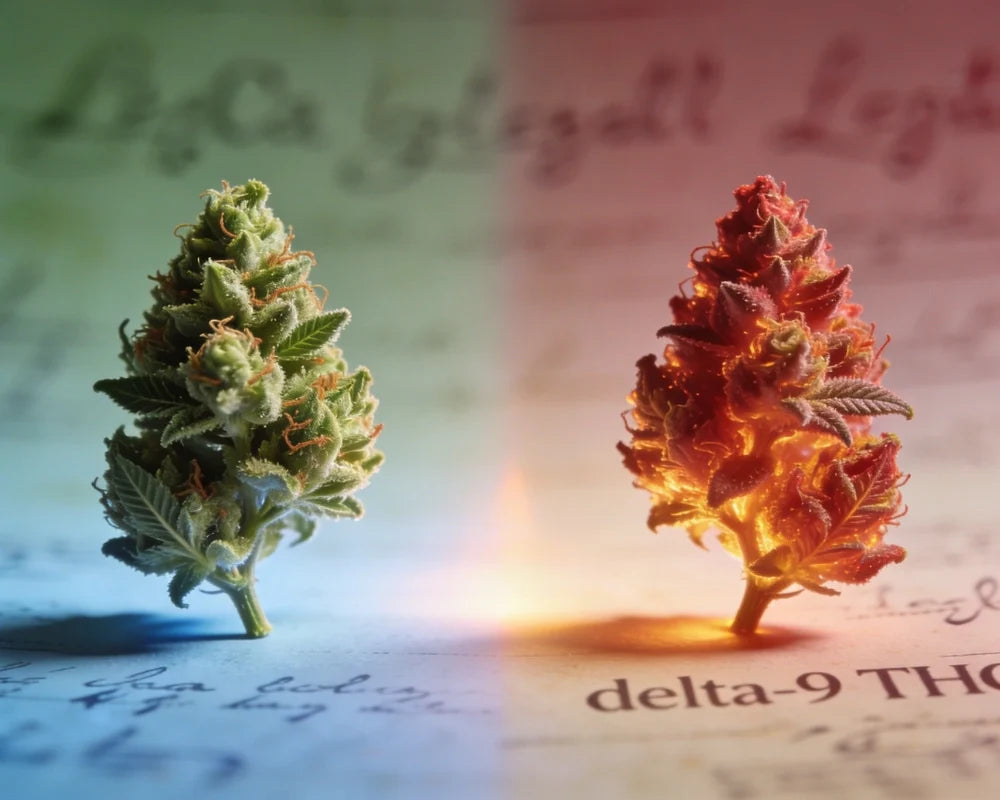
THCa and delta-9 THC are closely related molecules that produce the same effect when you consume them in the same way — but they have been treated very differently by federal and state law for the past seven years. Understanding the legal difference between THCa and delta-9 THC is not just interesting background knowledge; it's the foundational explanation for why Canapuff's products are legal to purchase and ship in most US states while marijuana products from the same plant are not.
This article explains the chemistry that underlies the legal distinction, how federal law has treated the two compounds differently, where the distinction does and doesn't protect you, and how the November 2025 law changes the picture going into 2026.
Legal disclaimer: This article is for general informational purposes only and does not constitute legal advice. Laws regarding THCa and delta-9 THC are changing rapidly. Nothing in this article should be relied upon as legal guidance for your specific situation. Consult a licensed attorney if you need legal advice.
The One Molecule That Changes Everything
THCa (tetrahydrocannabinolic acid) and delta-9 THC (tetrahydrocannabinol) are almost identical molecules. They share the same basic chemical architecture — a tricyclic ring structure with attached hydrocarbon chains. The difference between them is a single carboxyl group (-COOH) attached to THCa's molecular structure that is absent in delta-9 THC.
This carboxyl group — one extra cluster of atoms — is what separates legal hemp from marijuana in pre-activation testing, what prevents THCa from producing psychoactive effects in its raw form, and what makes the entire legal hemp THCa market possible under the 2018 Farm Bill.
Why the carboxyl group matters pharmacologically
The carboxyl group makes the THCa molecule larger and bulkier than delta-9 THC. CB1 receptors — the brain receptors that produce cannabis's psychoactive effects — have a binding pocket that accommodates the precise shape of activated delta-9 THC. THCa's bulkier shape doesn't fit this binding pocket properly. The result: raw THCa cannot meaningfully activate CB1 receptors and does not produce a high.
This is not a metaphor or an approximation — it's the documented pharmacological explanation for why eating raw hemp flower doesn't get you intoxicated, while smoking or vaping it does. The heat of combustion or vaporization removes the carboxyl group through a process called decarboxylation, producing the smaller delta-9 THC molecule that fits perfectly into CB1 receptors.
The decarboxylation conversion
When THCa is heated above approximately 230°F (110°C), the carboxyl group is removed as carbon dioxide (CO₂), and the remaining molecule is delta-9 THC. This conversion is near-complete during smoking and vaping. The standard conversion factor used in cannabis testing is 0.877 — meaning 1% THCA produces approximately 0.877% delta-9 THC when fully decarboxylated. A product with 25% THCa would produce approximately 21.9% delta-9 THC when smoked or vaped.
How Federal Law Has Treated the Distinction
Under the 2018 Farm Bill (current operative law through November 2026)
The 2018 Farm Bill defined hemp as cannabis containing delta-9 THC — specifically and only delta-9 THC — at 0.3% or less by dry weight. THCa is not delta-9 THC. The law's specific reference to delta-9 THC means that THCa concentration is simply not measured as part of the compliance threshold. A plant testing at 25% THCa and 0.2% delta-9 THC is federally legal hemp.
This is the legal foundation for the entire THCa hemp market. The law as written measures one specific compound (delta-9 THC) and excludes from regulated commerce only cannabis that exceeds the threshold for that specific compound. THCa in its natural, unheated form is a different compound that was not included in the measurement.
How DEA interpreted the distinction
The Drug Enforcement Administration has largely maintained that hemp-compliant products testing below 0.3% delta-9 THC are not controlled substances, even with high THCa content — provided the THCa is naturally occurring in the plant rather than synthesized. DEA's more restrictive position has been reserved for cannabinoids that are synthesized or chemically converted from other compounds (such as delta-8 THC produced by converting CBD), which the DEA has treated as outside the hemp exemption. Naturally grown hemp flower with high THCa content has generally been treated as legal hemp under DEA guidance consistent with the Farm Bill standard.
Under P.L. 119-37 (effective November 12, 2026)
The November 2025 law closes this distinction by expanding the measurement to total THC including THCA. Once this law takes effect, the carboxyl group difference will no longer provide the legal separation between hemp and marijuana at the federal level. A product with 25% THCa would exceed the 0.3% total THC threshold by an enormous margin and would be classified as marijuana — a Schedule I controlled substance — regardless of its delta-9 THC content at the time of testing.
The Legal Distinction in Practice: A Side-by-Side Comparison
| THCa Hemp Flower | Delta-9 THC (Marijuana) | |
|---|---|---|
| Federal classification (current) | Hemp — not a controlled substance; legal under 2018 Farm Bill | Marijuana — Schedule I controlled substance under federal CSA |
| Compliance measurement (current) | Delta-9 THC at or below 0.3% by dry weight | Delta-9 THC above 0.3% by dry weight = marijuana classification |
| Typical product percentage | 15–30%+ THCa; less than 0.3% delta-9 THC | 15–30%+ delta-9 THC in dispensary cannabis |
| Effect when smoked/vaped | Effectively identical — THCa converts to delta-9 THC through heat | Same psychoactive effects; direct delta-9 THC without conversion step |
| Interstate shipping | Legal — hemp can be shipped via USPS and private carriers | Federal crime — marijuana is a controlled substance; shipping is illegal |
| Drug test result | Positive — THCa converts to delta-9 THC which produces THC-COOH metabolites | Positive — same metabolites detected |
| Where available to purchase | Online retailers, smoke shops, specialty stores in most states | Licensed dispensaries in states with medical or recreational programs only |
| Federal classification (after Nov. 2026) | Would shift to marijuana / Schedule I if law takes effect as written | Unchanged (or Schedule III if marijuana rescheduling proceeds) |
Where the Legal Distinction Does NOT Protect You
The legal difference between THCa and delta-9 THC is real and meaningful in most purchasing and possession contexts — but it has important limits that every buyer should understand.
Drug testing: zero protection
Standard urine drug screens detect THC-COOH — a metabolite produced when the liver processes active delta-9 THC. When you smoke or vape THCa flower, it converts to active delta-9 THC, which then produces THC-COOH. The drug test cannot distinguish whether that THC-COOH came from a federally legal hemp product or an illegal marijuana product. The legal classification of the product you purchased provides absolutely no protection from a positive drug test result. If your employment, professional license, or legal status depends on passing drug tests, THCa products present the same risk as marijuana.
Law enforcement in the field: recognition gap
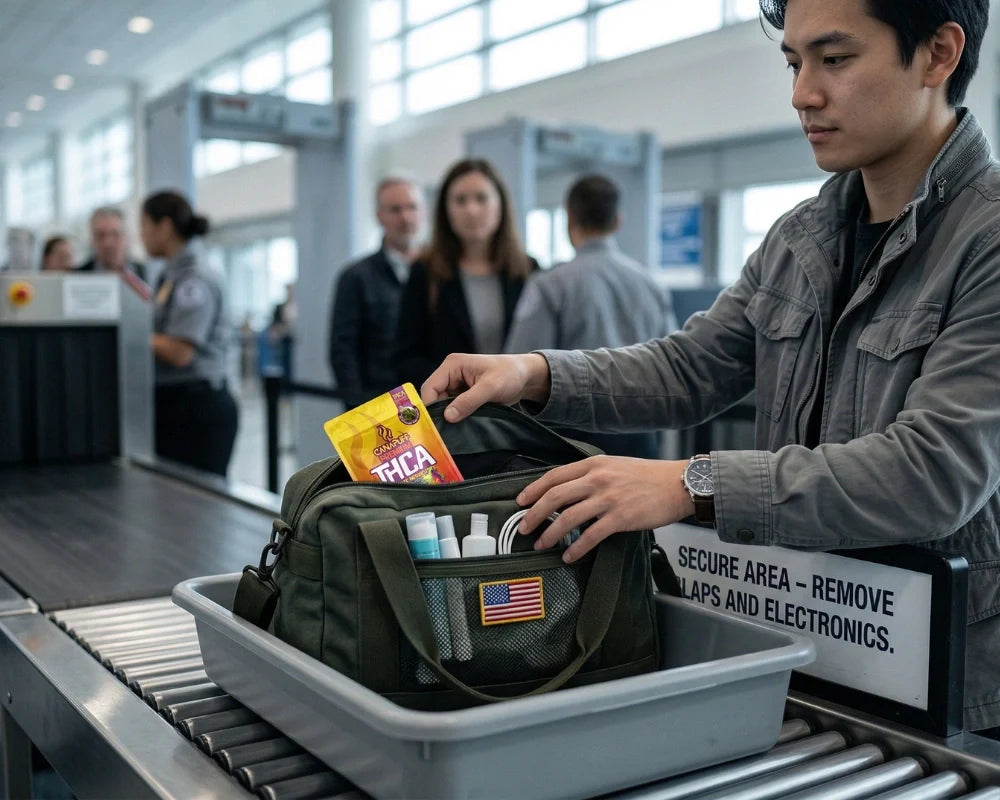
Hemp-compliant THCa flower is visually, aromatically, and texturally indistinguishable from marijuana. Law enforcement officers in the field cannot identify hemp from marijuana by looking at or smelling it. Field THC test kits used by many police departments test positive for THC in both hemp and marijuana. This creates a real-world risk: even with a legally purchased, Farm Bill compliant product, you may encounter law enforcement who initially treat it as marijuana until documentation can be reviewed and interpreted.
Carrying your Certificate of Analysis (COA) when transporting THCa products — particularly across state lines — provides the best protection in these encounters. A COA showing delta-9 THC below 0.3% is the primary documentation supporting hemp legal status.
State law: not preempted by federal hemp status
Federal hemp legality does not override state law. In states like Idaho that prohibit all THC-related cannabinoids regardless of their hemp origin, the fact that your product is federally legal hemp provides no protection under state law. Your state law governs what you can legally possess within that state.
Intent and marketing: a potential legal complexity
Some legal scholars have argued that products marketed specifically for the purpose of being heated to produce active THC — where the primary commercial purpose is the intoxicating effect, not any unactivated property of THCa — could be treated differently by regulators than products positioned as hemp wellness items. This argument has not been broadly adopted by courts or regulators, but it is a theoretical consideration worth understanding. Canapuff markets its products as legal hemp products sold in compliance with the 2018 Farm Bill.
The Practical Consumer Summary
If you purchase a Canapuff THCa product today:
- You are purchasing a federally legal hemp product under current federal law
- You are not purchasing a marijuana product as defined under the federal Controlled Substances Act
- Your product is the same plant, same chemical profile as dispensary marijuana when activated — the legal distinction is in the pre-activation chemistry and the testing methodology
- The product will register on a drug test exactly as marijuana would — the legal distinction does not transfer to drug testing
- Your state's law governs your possession of the product within your state — federal hemp legality does not override stricter state laws
- This legal framework is operative through November 12, 2026, after which significant changes to the federal definition are scheduled to take effect unless Congress acts
Frequently Asked Questions
If THCa converts to delta-9 THC when I smoke it, am I breaking a law by using it?
Under current federal law, no. The 2018 Farm Bill's hemp exemption applies to the product at the point of sale and testing — not at the point of use. The law does not make it illegal to heat a legal hemp product in a way that produces active THC. This is a genuine feature of the legal framework, not an exploitation of a loophole — though it is the characteristic that critics have called the "THCa loophole." Whether your state's law addresses the post-decarboxylation product differently is a state-specific question.
What's the difference between THCa and delta-8 THC legally?
They are in very different legal positions. THCa is a naturally occurring compound produced by the hemp plant through its normal biosynthesis pathway. Delta-8 THC occurs in trace amounts naturally but is primarily produced commercially through chemical conversion of CBD. The DEA has taken the position that chemically converted delta-8 is a synthetic cannabinoid outside the hemp exemption, and the November 2025 law explicitly excludes synthesized cannabinoids. THCa from naturally grown hemp flower has faced less regulatory hostility than delta-8 products, though the November 2025 law addresses both.
Does buying THCa appear on a background check?
Purchasing a legal hemp product from a compliant retailer does not create a criminal record and would not appear on a standard background check. Background checks typically show criminal convictions, not legal purchases. However, if possession of THCa in your state resulted in a criminal charge — for instance, if you were in a state that prohibits it and law enforcement didn't accept the hemp documentation — that charge could appear on a background check like any other charge.
This article is for general informational purposes only and does not constitute legal advice. All Canapuff hemp products contain less than 0.3% delta-9 THC by dry weight and comply with applicable federal law as of the date of sale. These statements are not legal opinions. Laws are subject to change. Must be 21+. Not available in HI, ID, MN, OR, RI, UT, or VT.
Leave a comment
This site is protected by hCaptcha and the hCaptcha Privacy Policy and Terms of Service apply.