
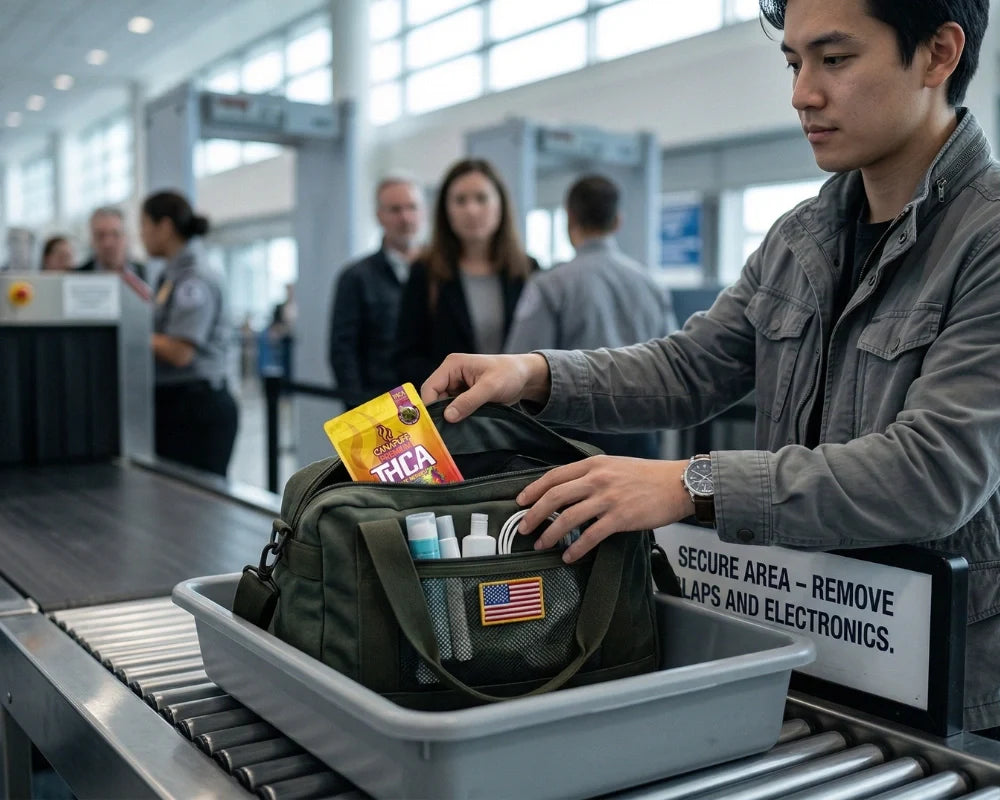
Traveling with THCa products is one of the most frequently asked legal questions from hemp consumers — and one that deserves a genuinely honest answer rather than the reflexive "yes, it's federally legal" response that ignores real-world risk. The nuanced truth: traveling by car through states where THCa is legal carries very little legal risk with proper documentation. Flying domestically is technically possible for compliant hemp products but involves meaningful practical uncertainty. Crossing into restricted states is a genuine legal exposure regardless of your product's federal compliance.
This article covers every major travel scenario — car travel, air travel, and interstate transport — with specific guidance on what documentation helps, what situations create real risk, and how to make informed decisions about whether to travel with THCa products at all.
Legal disclaimer: This article is for general informational purposes only and does not constitute legal advice. Laws on this topic vary significantly by state and are changing. Canapuff makes no representations about the legality of traveling with hemp products in your specific state or situation. When in doubt, consult a licensed attorney and check your state's current law before traveling with any cannabis-related product.
The Core Legal Framework for Traveling with THCa
Under federal law (currently operative through November 2026), hemp products containing less than 0.3% delta-9 THC by dry weight are legal to possess, transport, and ship. The 2018 Farm Bill did not restrict the movement of compliant hemp products across state lines — it actually includes language protecting interstate transport of hemp.
However, two critical factors complicate traveling with THCa specifically:
- Federal property operates under federal law — including airports and aircraft. TSA and federal aviation authorities operate under federal jurisdiction where cannabis remains classified as a controlled substance under the Controlled Substances Act, and they do not distinguish between compliant hemp and marijuana without documentation and testing.
- Destination state law governs what you can legally possess when you arrive. Even if your product was legally purchased and legally shipped under federal hemp law, the laws of the state you're driving or flying into govern whether you can legally possess it upon arrival.
Traveling by Car: The Most Straightforward Scenario
Road travel with federally compliant THCa products through states where THCa is legal presents the fewest complications of any travel scenario. You are transporting a federally legal agricultural commodity — and if both your origin and destination states permit hemp flower, your legal position is clear. That said, practical precautions significantly reduce any risk of complications.
Always carry your COA
Your Certificate of Analysis is the single most important document for travel with THCa products. A COA from an accredited third-party laboratory showing delta-9 THC at or below 0.3% is the primary documentation demonstrating federal hemp compliance to law enforcement. A COA showing a compliant lab result from a credible laboratory dramatically changes any law enforcement interaction from a potentially criminal matter to a documentation review.
Canapuff's COAs are available for all products. Print or save a digital copy on your phone and keep it with your products when traveling. The product batch number on the COA should match the product you're carrying.
Keep products in original sealed packaging
Original labeled packaging demonstrates that this is a retail product — not an unpackaged controlled substance. A product in professional packaging with a product label, cannabinoid information, and a QR code or reference to a COA is far less likely to create a field enforcement issue than loose flower in a baggie.
Store in the trunk or inaccessible area in vehicles
In most states, open container or consumption-in-vehicle laws that apply to alcohol also apply to cannabis products. While hemp flower isn't alcohol, the safest practice is to treat it the same way — stored in the trunk or in a sealed bag in an area not accessible to the driver during travel. This removes any suggestion of active consumption while driving.
Know your route's state laws
If you're driving through multiple states, each state's laws apply to your possession within its borders. Driving from a permissive state through a total THC state like Georgia or a prohibition state like Idaho even briefly creates legal exposure. Canapuff's restricted states list (HI, ID, MN, OR, RI, UT, VT) gives you a starting framework, but the rapidly evolving state landscape means verifying current law for every state on a long-distance route is advisable.
Flying Domestic: Where It Gets Complicated
The TSA's official position on hemp products is clear in principle and uncertain in practice. TSA's stated policy explicitly acknowledges the 2018 Farm Bill's hemp exemption:
"Marijuana and certain cannabis-infused products, including some Cannabidiol (CBD) oil, remain illegal under federal law except for products that contain no more than 0.3 percent THC on a dry weight basis or that are approved by FDA." — TSA Official Policy
The same policy statement continues: "TSA officers are required to report any suspected violations of law to local, state, or federal authorities."
This creates a practical gap. TSA's primary mission is aviation security — finding weapons, explosives, and threats — not drug enforcement. TSA officers are not trained to distinguish hemp from marijuana, do not have on-site testing equipment to verify delta-9 THC levels, and generally cannot read a COA with the same understanding as a cannabis industry compliance officer.
What actually happens at TSA if they find THCa flower
Based on the pattern of documented encounters: TSA officers are unlikely to proactively search for cannabis products. If they detect what appears to be cannabis flower during X-ray screening or bag check, they will typically alert a law enforcement officer. What happens next depends heavily on the airport location and local law enforcement's approach:
- In legal recreational states (California, Colorado, Nevada, etc.): Local law enforcement at airports in these states often take a pragmatic approach. Compliant hemp documentation may resolve the situation, or local officers may confiscate the product without charges and allow you to proceed.
- In non-legal or restricted states: Local law enforcement may take a more serious view, particularly of flower products that are visually and aromatically identical to marijuana. The risk of charges, delay, or confiscation is higher even with compliant documentation.
- Across all airports: The outcome depends significantly on the individual officer. There is no guaranteed outcome even with a COA in hand.
Importantly: even Denver International Airport — in Colorado where recreational marijuana is fully legal — prohibits cannabis on airport property. Airport-specific rules add another layer beyond state law.
THCa vapes and gummies vs. flower on flights
Format matters significantly for the practical risk of air travel:
- Gummies: Federally compliant hemp gummies (properly labeled with cannabinoid information and under the delta-9 threshold) are the least likely to be flagged. They look like standard food products and don't have the unmistakable aroma of cannabis flower. Keep them in original labeled packaging.
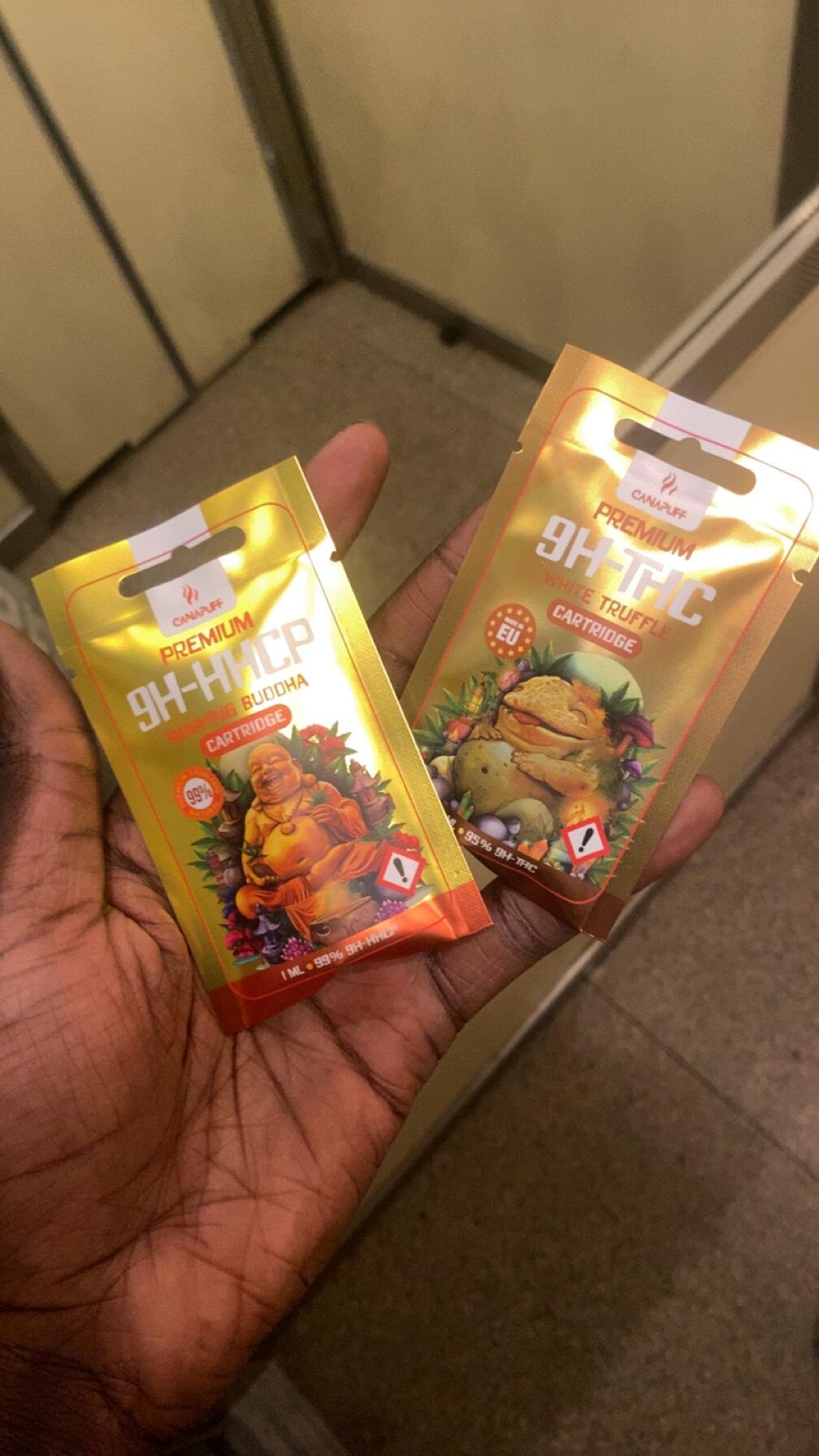
- Vape cartridges: Subject to standard TSA liquid/battery rules (lithium batteries in carry-on only, not checked). The oil cartridge itself may not be flagged if it doesn't smell strongly of cannabis. However, disassembling a vape from its battery increases detection uncertainty.
- Flower: Presents the highest travel risk of any format. Cannabis flower is aromatic, visually distinctive, and will be treated as a potential marijuana violation by most TSA officers without the ability to verify your COA on the spot. Our honest recommendation: leave flower at home when flying.
International Travel: Do Not.
Do not attempt to travel internationally with any THCa or hemp-derived THC product. International customs screening is more thorough than TSA, other countries do not recognize the 2018 Farm Bill's hemp classification, and some international destinations (Japan, Singapore, UAE, and others) impose severe criminal penalties for cannabis possession — including what qualifies as federally legal hemp in the United States. The risk is not worth it under any circumstances.
The Practical Recommendation
The most risk-free approach: Purchase THCa products at your destination rather than traveling with them. If you're visiting a state where Canapuff ships, you can order ahead to your destination address. This completely eliminates travel-related legal uncertainty regardless of your travel method.
If you do choose to travel with THCa products:
- By car between permissive states: travel with original packaging and your COA. Low risk.
- By plane with gummies or compliant edibles: keep original packaging, carry COA, accept that outcomes are not guaranteed.
- By plane with flower: the practical risk level does not justify the convenience. Order at your destination.
- Through restricted states regardless of travel method: evaluate carefully — your product's federal compliance doesn't override state law at your destination.
Frequently Asked Questions
Can I check THCa flower in my luggage instead of carry-on?
Checked baggage passes through TSA screening as well. While checked bags receive less intensive X-ray scrutiny than carry-on in many airports, TSA does screen checked bags and can open them for manual inspection. The same practical risks apply. Additionally, the strong aroma of cannabis flower can be detectable even through sealed packaging during checked bag handling. Checked luggage is not a safer alternative to carry-on for flower.
Does having a medical card help when traveling with THCa?
A medical marijuana card from a state-licensed program does not provide federal travel protection — it's a state-issued document that has no legal authority in federal jurisdiction (airports, aircraft). However, a hemp product COA demonstrating delta-9 THC compliance under 0.3% does have direct relevance to federal hemp law and is more useful documentation for THCa travel than a medical card.
What if I drive from a legal state into a non-legal state with THCa products?
The law of the state you enter governs your possession within that state. Federal hemp legal status does not override state law. If you drive from Florida (permissive) into a state that uses total THC testing and your product would fail that test, you are in legal jeopardy once you cross the border regardless of your product's federal compliance. Know the law of every state you're passing through — not just your origin and destination.
This article is for general informational purposes only and does not constitute legal advice. All Canapuff products comply with applicable federal law as of the date of sale and contain less than 0.3% delta-9 THC by dry weight. Canapuff makes no representation that traveling with these products is legal in any specific state, location, or context. Customers are responsible for compliance with all applicable laws. Must be 21+. Not available in HI, ID, MN, OR, RI, UT, or VT.
Leave a comment
This site is protected by hCaptcha and the hCaptcha Privacy Policy and Terms of Service apply.