
Table of contents
- What Microdosing THCa Actually Means ›
- What the Research Says About Low-Dose THC ›
- Why Flower Is Harder to Microdose Than Gummies or Tinctures ›
- How to Calculate a Microdose From THCa Flower ›
- Step-by-Step: How to Microdose THCa Flower ›
- Microdosing With THCa Vapes vs. Flower ›
- Microdosing With Gummies ›
- Who Benefits Most From Microdosing? ›
- What Microdosing Won't Do ›
- Frequently Asked Questions ›
Microdosing cannabis has moved from niche wellness practice to mainstream conversation — and for good reason. The idea that using less can actually deliver more reliable, functional benefits runs counter to how most people first approach THCa flower. But the science behind it is consistent: smaller, sub-intoxicating doses of THCa can engage the endocannabinoid system in ways that provide mood support, mild pain relief, reduced anxiety, and improved focus — without the pronounced high that makes regular daytime use impractical for most people.
This guide covers what microdosing THCa actually means, what the research says about low-dose THC effects, how to calculate and execute a microdose from hemp flower specifically, and which products in Canapuff's range are best suited to a microdosing approach.
Important disclaimer: This article is for educational and informational purposes only. THCa hemp products are not approved by the FDA to diagnose, treat, cure, or prevent any condition. Microdosing does not eliminate the psychoactive potential of THCa — it manages the threshold. All Canapuff products will still register on standard drug tests regardless of dose. Must be 21+. Consult a healthcare provider before using hemp products alongside any medical treatment.
What Microdosing THCa Actually Means
Microdosing refers to consuming an amount of THCa (which activates to THC when smoked or vaped) that is small enough to remain sub-psychoactive — or at the very lowest edge of perceptible effect. The goal is not zero effect; it's a controlled, functional effect without impairment.
In general cannabis wellness literature, a microdose of activated THC is typically defined as 1–5mg. A standard recreational dose is typically 10–20mg. An ultra-low or sub-perceptual dose is 0.5–2.5mg. Most people who microdose effectively settle into a range between 1–3mg of active THC per session — a fraction of what's in even a modest standard serving.
The biphasic principle: THC follows a well-documented biphasic dose-response pattern. At low doses, it tends to reduce anxiety, improve mood, and provide gentle pain relief. At higher doses, the same compound can increase anxiety, impair cognition, and produce sedation. Microdosing deliberately stays in the beneficial low-dose range. This isn't a theory — it's one of the most replicated findings in cannabinoid research.
What the Research Says About Low-Dose THC
The research specifically on low-dose and microdose THC is increasingly robust:
- Pain relief at ultra-low doses. An Israeli clinical trial using an inhaler device found that doses as low as 0.5–1mg of THC delivered significant, rapid pain relief lasting up to 150 minutes — without any cognitive impairment in participants. This is among the strongest clinical evidence that sub-intoxicating THC doses have real physiological effects.
- Anxiety reduction at low, not high, doses. A study examining THC across dose ranges found that lower doses reliably reduced anxiety in a simulated social stress scenario (mock job interview), while higher doses increased it. The anxiety-relieving window closes as dose increases — another strong argument for staying low.
- Cancer pain: less is more. In a study of cancer patients who were unresponsive to traditional opioid pain management, those receiving the lowest daily doses of a combined THC+CBD formulation (approximately 10mg each) achieved the greatest pain reduction. The high-dose group (30mg+) actually experienced increased pain sensation — a striking reversal that illustrates just how consequential dose calibration is with cannabinoids.
- PTSD outcomes with microdoses. Research on PTSD patients using low daily doses (2 x 5mg THC/day) found improved sleep, fewer nightmares, reduced anger and agitation — all at doses well below typical recreational use.
- Cognitive performance in older adults. A 2018 study found that low-dose THC enhanced cognitive performance in older adult test subjects — a finding that contrasts sharply with the well-documented cognitive impairment seen at recreational doses.
The picture that emerges across this research is consistent: the therapeutic window for THC is real, relatively narrow, and significantly lower than most recreational use patterns. Microdosing is essentially the practice of deliberately staying inside that window.
Why Flower Is Harder to Microdose Than Gummies or Tinctures
Before getting into the how-to, it's worth being honest about a practical challenge: hemp flower is inherently less precise for microdosing than gummies or tinctures. Here's why:
- Cannabinoid distribution in flower is not perfectly uniform. Different parts of the same bud can have slightly different THCa concentrations. A 2024 study suggested that the cannabinoid content of flower may sometimes vary by up to 20% from labeled values across different samples.
- Inhalation variables affect absorbed dose. How deeply you inhale, how long you hold, the temperature of combustion — all of these affect how much THCa is activated and how much you actually absorb. Two people taking the same size draw will absorb different amounts.
- Individual bioavailability varies. Body weight, metabolism, tolerance, and even whether you've eaten recently all affect how much effect a given dose produces.
None of this makes flower microdosing impossible — but it means the approach requires more awareness and self-monitoring than a precisely measured 2.5mg gummy. The practical solutions are covered in the step-by-step section below.
How to Calculate a Microdose From THCa Flower
Here's a practical method for estimating your dose from flower:
- Check the THCa percentage on the COA. Canapuff's greenhouse strains typically run 18–22% THCa. Indoor strains run 22–26%. Exotic strains run 25–30%+.
- Convert percentage to mg/gram. A 20% THCa strain contains approximately 200mg THCa per gram of flower. With a rough conversion rate of ~87.7% (the weight of THC relative to THCa after decarboxylation), 200mg THCa ≈ 175mg active THC per gram when fully combusted. In practice, inhalation bioavailability means you absorb roughly 30–50% of that — so approximately 50–90mg of active THC per gram is a rough real-world estimate. This varies significantly based on technique.
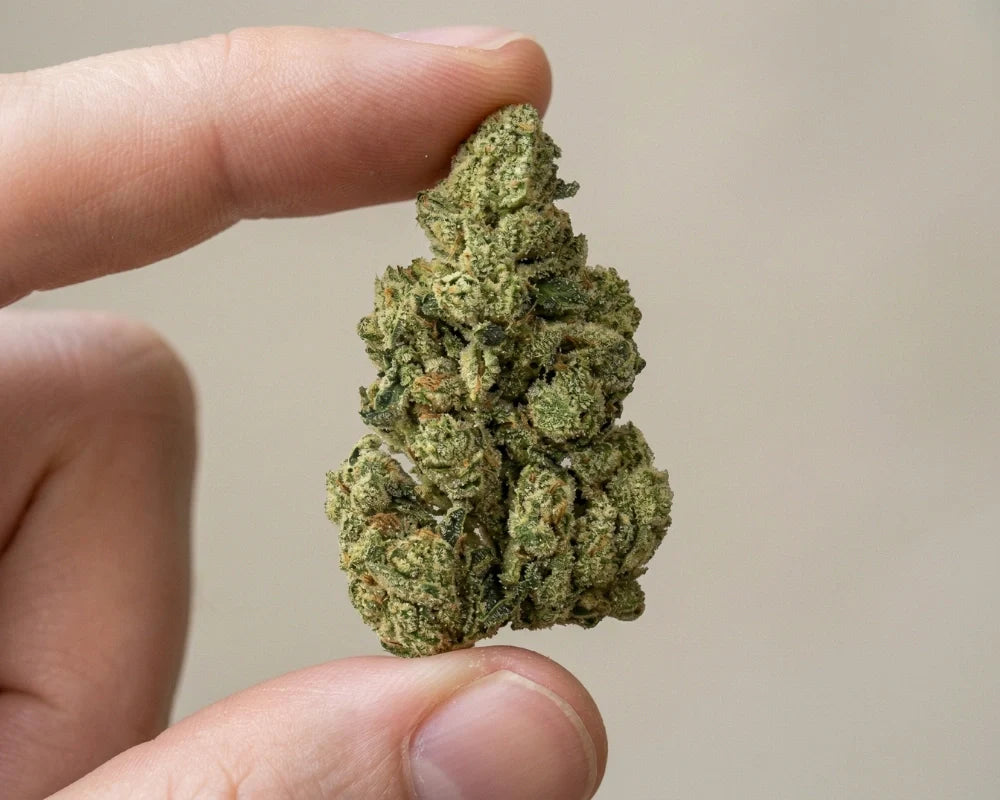
- Work backwards to a target dose. For a 2.5mg microdose target: 2.5mg ÷ 70mg per gram (midpoint estimate) = approximately 0.036 grams, which is about 1/28th of a gram. That is a very small amount — roughly a tiny pinch, not even a full small bowl. In practice, this translates to one modest draw, not a full bowl or joint.
The practical takeaway: A microdose from flower is literally one careful draw — hold briefly, exhale, wait 10–15 minutes, then assess. It is not a half-joint or a fully loaded bowl. Most people significantly overshoot on their first few attempts because standard smoking habits involve far more than a microdose.
Step-by-Step: How to Microdose THCa Flower
Step 1: Choose the right strain
For microdosing, balanced hybrids and mild indicas are generally better starting points than high-THCa exotic strains. Greenhouse tier strains like Pink Runtz or Gorilla Glue (18–22% THCa) provide more margin for error than a 30%+ exotic, where the same volume of flower delivers a significantly larger dose. If your goal is daytime functional microdosing, a sativa-leaning hybrid with a terpene profile that includes limonene or pinene — rather than heavy myrcene — will stay more energizing and less sedating at low doses.
Step 2: Use a dry herb vaporizer when possible
Dry herb vaporizers that heat flower without combustion provide more dose control than smoking. Lower temperature settings (around 170–185°C / 338–365°F) activate THCa and the major terpenes without extracting every compound — which can actually reduce the per-draw potency compared to full combustion. This gives you additional buffering room in a microdosing context.
Step 3: One draw, then wait
Take a single, measured draw. Not a large rip — a modest inhalation held for 3–5 seconds. Then wait. Inhalation onset is typically 5–15 minutes. The peak effect arrives around 20–40 minutes. Do not take a second draw until you've waited a full 15–20 minutes and assessed how you feel. The most common microdosing mistake is dosing again before the first dose has fully expressed itself.
Step 4: Keep a dose journal for the first two weeks
Log the strain, the approximate amount (your best estimate), the time, what you were doing, and how you felt at 20 minutes and 60 minutes. Within a week or two, consistent patterns emerge — you'll know which strains at which amounts produce the functional state you're targeting. This structured self-observation is what converts microdosing from guesswork into a reliable practice.
Step 5: Calibrate and set a baseline
Once you've found the amount that produces your desired minimal noticeable effect, stick with it for two to three days to assess consistency before adjusting. Most wellness practitioners who work with cannabis microdosing recommend starting at 1mg equivalent, maintaining for 2–3 days, and increasing by 0.5mg increments only if needed. Never increase the same day you increased — let the system settle.
Microdosing With THCa Vapes vs. Flower
THCa disposable vapes offer somewhat more consistent dose-per-draw estimates than flower, because the oil is homogeneous and the draw mechanism is standardized. A single short draw from a Canapuff disposable vape (Purple Runtz, Green Crack, or Northern Lights) is likely in the 1–3mg activated THC range depending on draw length and the specific oil concentration — squarely in microdose territory for most users.
For daytime functional microdosing, Green Crack (sativa) or Purple Runtz (hybrid) disposable vapes are better choices than indica-dominant Northern Lights, which has a terpene and cannabinoid profile oriented toward sedation rather than daytime alertness.
Microdosing With Gummies
For users who want the most dose-precise microdosing option, THC gummies are the most controllable format. Canapuff's gummies start at $4.95 and can be cut or portioned into fractions. A gummy containing 10mg of THC can be cut into quarters for 2.5mg doses — the most commonly recommended starting microdose in clinical and wellness literature.
The tradeoff with gummies is onset time — 45–90 minutes before effects are felt, and up to 2 hours to reach peak. This makes real-time dose adjustment impossible. The rule: if you're microdosing with gummies, take your small dose and then wait at least 2 hours before any reassessment. Redosing too soon with edibles is one of the most common causes of overshooting the microdose threshold.
Who Benefits Most From Microdosing?
- New or returning users who want to explore THCa effects without risking an overwhelming first experience
- Experienced users who want to reduce tolerance — regular microdosing at low doses, particularly with periodic breaks, can recalibrate the endocannabinoid system and restore sensitivity to lower doses
- Daytime wellness users who want mood support, mild stress relief, or gentle creativity enhancement without impairment
- People managing chronic low-level discomfort who need to remain functional throughout the day
- Anyone who has had anxiety or paranoia experiences from standard doses — microdosing keeps THC firmly below the threshold where those effects typically appear
What Microdosing Won't Do
Being honest about limitations matters for setting realistic expectations:
- Microdosing will not eliminate a drug test positive result. THC metabolites accumulate regardless of dose, and regular low-dose use will still be detectable on standard urine screens.
- It won't replace medical treatment for diagnosed conditions. Sub-therapeutic doses of cannabinoids are a wellness tool, not a medical protocol.
- It doesn't work identically for everyone. Individual ECS variation means one person's perfect microdose is another's nothing or too much. Self-experimentation and careful tracking are essential.
- Tolerance still develops with regular microdosing over time, just more slowly than with standard doses. Periodic breaks — even a few days every few weeks — help maintain the low-dose efficacy.
Frequently Asked Questions
Can I microdose THCa flower and drive?
No. Even at microdose levels, THCa activates THC which may affect reaction time, judgment, and coordination, and you will be legally impaired under most state DUI/DWI statutes regardless of the dose consumed. Never drive under the influence of any activated THCa product.
Will microdosing make me feel high?
A well-calibrated microdose should produce little to no perceptible intoxication — a subtle mood lift, mild relaxation, or gentle increase in sensory enjoyment is more typical than a pronounced high. If you're clearly feeling high, you've exceeded the microdose threshold. Back down on the next session.
How often can I microdose?
This varies by individual and goal. Some microdosers use a product once in the morning and once in the evening. Others use it only on specific occasions. Daily use, even at microdose levels, will build some degree of tolerance over time. Many experienced microdosers take two days off per week to prevent tolerance accumulation and maintain the system's sensitivity to low doses.
This article is for general educational and informational purposes only and does not constitute medical advice. All Canapuff hemp products contain less than 0.3% delta-9 THC. These statements have not been evaluated by the Food and Drug Administration. This product is not intended to diagnose, treat, cure, or prevent any disease or condition. Even microdosed THCa products will produce THC metabolites detectable on standard drug tests. Must be 21+ to purchase. Not available in HI, ID, MN, OR, RI, UT, or VT.
Leave a comment
This site is protected by hCaptcha and the hCaptcha Privacy Policy and Terms of Service apply.