
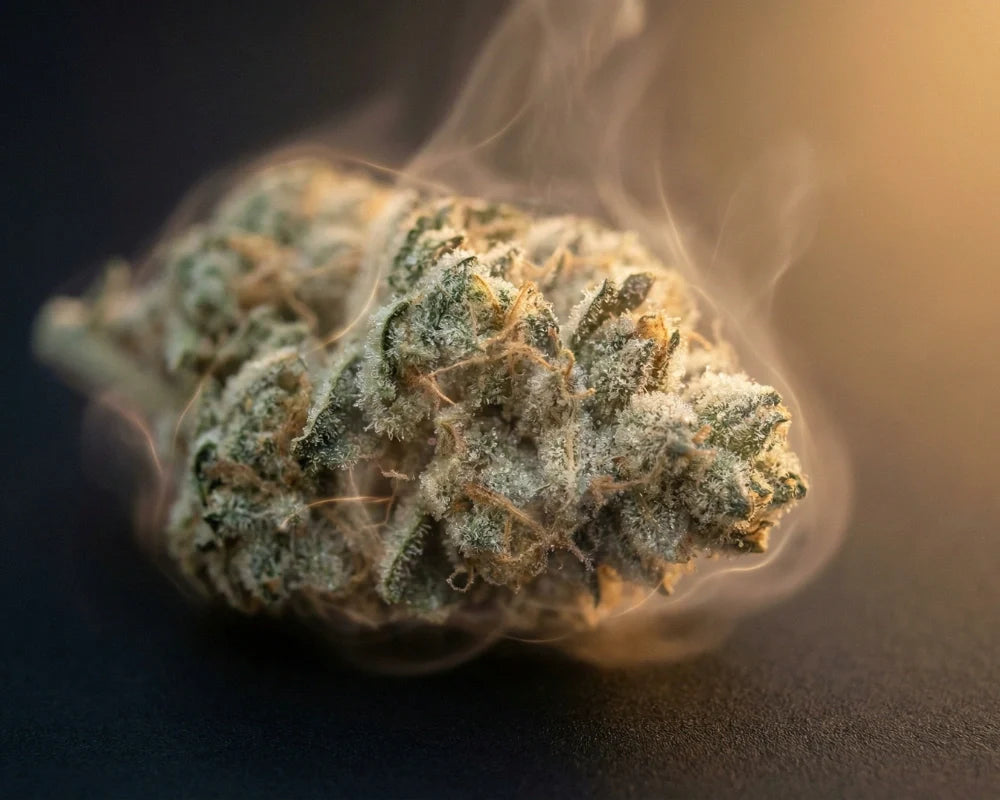
You light up, take a draw, and within minutes you feel it. But what actually happened in that split second between flame and effect? The answer is decarboxylation — a simple chemical reaction that transforms raw, non-psychoactive THCa into active THC the moment heat is applied. Here's exactly how it works, why it matters, and what affects how much THC you actually get.
Quick Answer: When you smoke or vape THCa flower, the heat instantly triggers decarboxylation — a chemical process that removes a carboxyl group (COOH) from the THCa molecule, releasing it as CO₂ and leaving behind active THC. The entire conversion happens in milliseconds. Roughly 87% of the THCa becomes THC; the rest burns off or remains unconverted.
What Is Decarboxylation?
Decarboxylation (often shortened to "decarb") is a chemical reaction driven by heat. The word breaks down simply: de (remove) + carboxyl (the COOH group) + ation (the process). It describes what happens when a carboxyl group is stripped from a molecule by thermal energy.
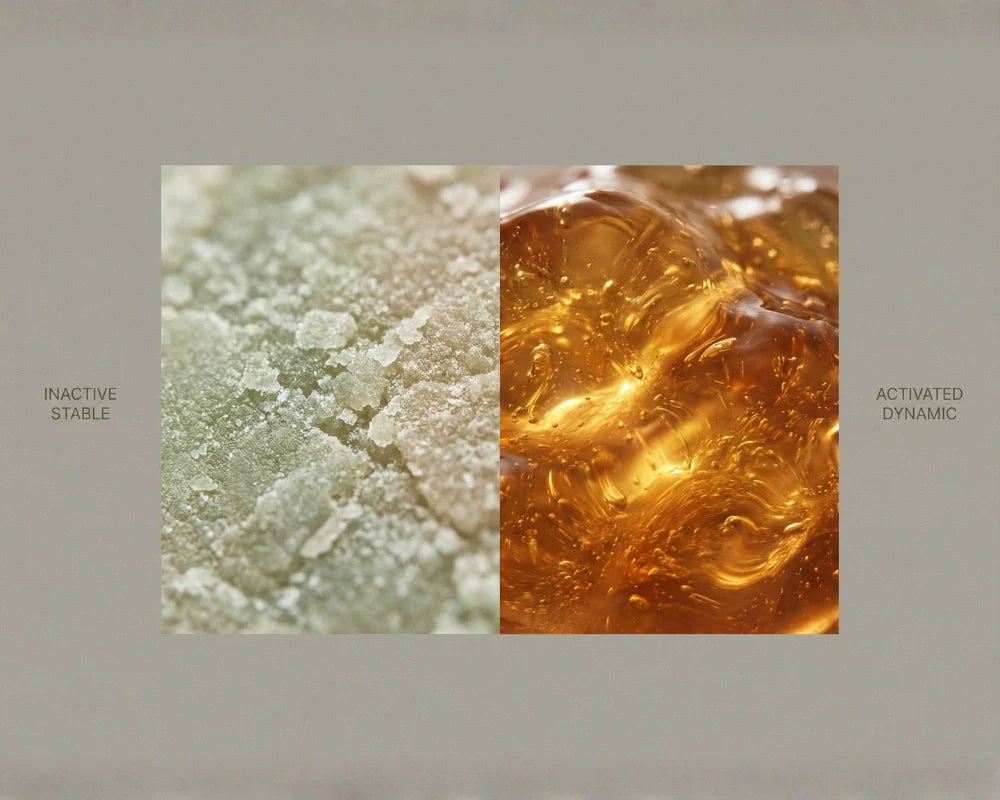
In the context of cannabis and hemp, decarboxylation is the essential step that switches THCa from its inactive, raw state into psychoactive THC. Without this reaction, THCa simply passes through your body without producing any intoxicating effect — no matter how much of it is present.
The cannabis plant doesn't naturally produce THC. It produces THCa. Every gram of flower you hold is packed with THCa waiting to be activated. Heat is the switch.
The Chemistry — Made Simple
THCa has the molecular formula C₂₂H₃₀O₄. THC has the formula C₂₁H₃₀O₂. The only structural difference is that extra carboxyl group — one carbon atom, two oxygen atoms, one hydrogen atom (COOH) — attached to the THCa molecule.
When heat is applied above roughly 220°F (104°C), that bond holding the COOH group to the molecule breaks. The carboxyl group exits as carbon dioxide (CO₂) gas — the same gas you exhale. What's left is THC: a lighter, smaller molecule with a shape that fits directly into CB1 receptors in the brain.
This is why the molecular weight drops during decarboxylation. THCa weighs 358.47 g/mol. THC weighs 314.45 g/mol. The 44-unit difference is the weight of the CO₂ that leaves. This is also why the conversion ratio isn't 1:1 — by weight, approximately 87.7% of THCa becomes THC.
The math in practice: A THCa vape or flower listed at 25% THCa delivers approximately 21.9% equivalent THC after activation. A 30% THCa exotic flower delivers roughly 26.3% equivalent THC. This is why high-THCa products hit hard.
What Happens When You Smoke THCa Flower
Smoking is the most direct and fastest form of decarboxylation. The moment a flame touches the flower, temperatures at the combustion point reach between 600–900°F (315–482°C) — far above the threshold needed for decarboxylation. The conversion from THCa to THC is virtually instantaneous.
The resulting THC vapor is absorbed through the alveoli in your lungs and enters the bloodstream within seconds. From there it crosses the blood-brain barrier and reaches CB1 receptors in the brain — which is why effects from smoking are felt almost immediately, typically within 1–3 minutes.
Does all the THCa convert when smoked?
Not quite. Combustion is fast and hot, which is efficient for decarboxylation but also degrades some of the THC produced before it can be inhaled. Some THCa also remains unconverted in the smoke. The practical conversion efficiency through smoking is generally estimated at around 75–88%, depending on technique, moisture content, and flower density.
What Happens When You Vape THCa
Vaporization heats the flower or extract to a controlled temperature — typically between 315–440°F (157–227°C) — without reaching combustion. This range is hot enough to trigger full decarboxylation of THCa into THC, but cool enough to avoid burning off cannabinoids and terpenes unnecessarily.
This makes vaping more efficient than smoking in terms of cannabinoid delivery. Less is wasted to combustion byproducts, and terpenes (which influence the character of the effect) are better preserved at lower temperatures. The onset is still very fast — 1–5 minutes — because THC is still absorbed through the lungs.
Smoking vs vaping — which converts more THCa?
| Method | Temp range | Conversion efficiency | Onset time |
|---|---|---|---|
| Smoking (joint / pipe) | 600–900°F | ~75–88% | 1–3 min |
| Vaping (disposable / cartridge) | 315–440°F | ~85–95% | 1–5 min |
| Oven decarb (for edibles) | 220–250°F | ~70–80% (slower, controlled) | 30–90 min (digestion) |
| Raw consumption (no heat) | None | ~0% (no conversion) | No psychoactive effect |
Can THCa Convert Without a Flame?
Yes — but slowly. Decarboxylation is triggered by heat in any form, not just an open flame. Two other conditions cause gradual, passive conversion:
- Time at room temperature. THCa naturally and slowly converts to THC during storage, especially once flower has been dried and cured. This is a normal part of the aging process and is one reason why very old cannabis can feel more sedating — THC also degrades over time into CBN, a mildly sedative cannabinoid.
- UV light and improper storage. Exposure to sunlight or leaving flower in a hot environment (like a car in summer) can trigger unintentional partial decarboxylation. This degrades the product, reducing THCa content before you ever consume it.
💡 Storage tip: To preserve maximum THCa content in your flower or vape, store it in an airtight, UV-blocking container away from heat and light. Cool, dark, and sealed is the rule. Refrigerating flower is fine; freezing can damage trichomes.
Why This Matters for Potency
Understanding decarboxylation explains something that confuses a lot of buyers: why a flower listed at 30% THCa and one listed at 22% THCa don't necessarily produce a 37% stronger experience. Several other factors shape the real-world effect:
- Terpene profile. Terpenes don't just create aroma — they interact with cannabinoids to shape the character and intensity of effects (the entourage effect). A well-preserved terpene profile in an indoor or exotic-grade flower can outperform a higher-THCa greenhouse product in terms of overall experience quality.
- Consumption method. As the table above shows, vaping is more efficient than smoking at delivering converted THC to your system. Technique and temperature both play a role.
- Individual tolerance. Your endocannabinoid system adapts with repeated use. Regular consumers need more THC to achieve the same effect as occasional users.
- Moisture content. Drier flower allows more even heat penetration, improving conversion consistency. Properly cured flower performs better than overly moist or improperly stored material.
What Happens to the THCa That Doesn't Convert?
Not all THCa becomes THC during smoking or vaping. A portion is destroyed by excessive heat before it can be inhaled, some remains as residual unconverted THCa, and some exits as combustion byproducts. Research has found trace amounts of unconverted THCa detectable in the blood and urine of cannabis consumers — meaning some raw THCa does make it into the body even after heating, though in small quantities.
This residual THCa is non-psychoactive, but it does mean the chemistry of consumption is more complex than a clean 100% conversion. In practice, this doesn't meaningfully affect the experience — but it's relevant for anyone thinking about lab testing or drug test accuracy.
Frequently Asked Questions
Does decarboxylation destroy terpenes?
High temperatures do degrade terpenes. This is one reason vaping at lower temperatures (315–380°F) preserves more of the strain's flavor profile than combustion. Many experienced users prefer lower-temp vaping specifically to retain terpenes while still achieving full THCa conversion.
If I cook with THCa flower, does it work the same way?
Yes — cooking triggers decarboxylation just like smoking or vaping. For edibles, the standard method is to heat flower in an oven at 220–240°F for 30–40 minutes before infusing into butter or oil. This lower, slower approach preserves more terpenes and cannabinoids compared to combustion. The resulting THC is then digested, metabolized by the liver (producing 11-hydroxy-THC), and absorbed more slowly — producing a longer, often more body-heavy effect with a 30–90 minute onset.
Does a THCa vape pre-heat do anything before I draw?
Yes. Most disposable vapes use a heating element that reaches the target temperature before or the moment you draw. The coil heats the THCa distillate and triggers instant decarboxylation — the vapor you inhale already contains activated THC, not raw THCa.
Can I speed up decarboxylation by using higher heat?
Up to a point. Higher temperatures do increase the speed of conversion, but above roughly 300°F (149°C) in a controlled setting (like an oven), THC itself begins to degrade into less potent or differently-acting compounds. Combustion during smoking exceeds these temperatures, which is why smoking is slightly less efficient than vaping for cannabinoid delivery — some THC is lost in the process.
This article is for general informational purposes only and does not constitute legal or medical advice. All Canapuff hemp products contain less than 0.3% delta-9 THC. These statements have not been evaluated by the Food and Drug Administration. This product is not intended to diagnose, treat, cure, or prevent any disease.
Leave a comment
This site is protected by hCaptcha and the hCaptcha Privacy Policy and Terms of Service apply.