

Table of contents
- Right Now (March 2026): THCa Is Federally Legal ›
- What Is Changing: P.L. 119-37 and the New Hemp Definition ›
- The Timeline: What Happens When ›
- The Congressional Response: Bills in Play Right Now ›
- The Marijuana Rescheduling Development ›
- State Laws: The Additional Layer ›
- What This Means for Canapuff Customers Right Now ›
- Frequently Asked Questions ›
- Sources & Further Reading ›
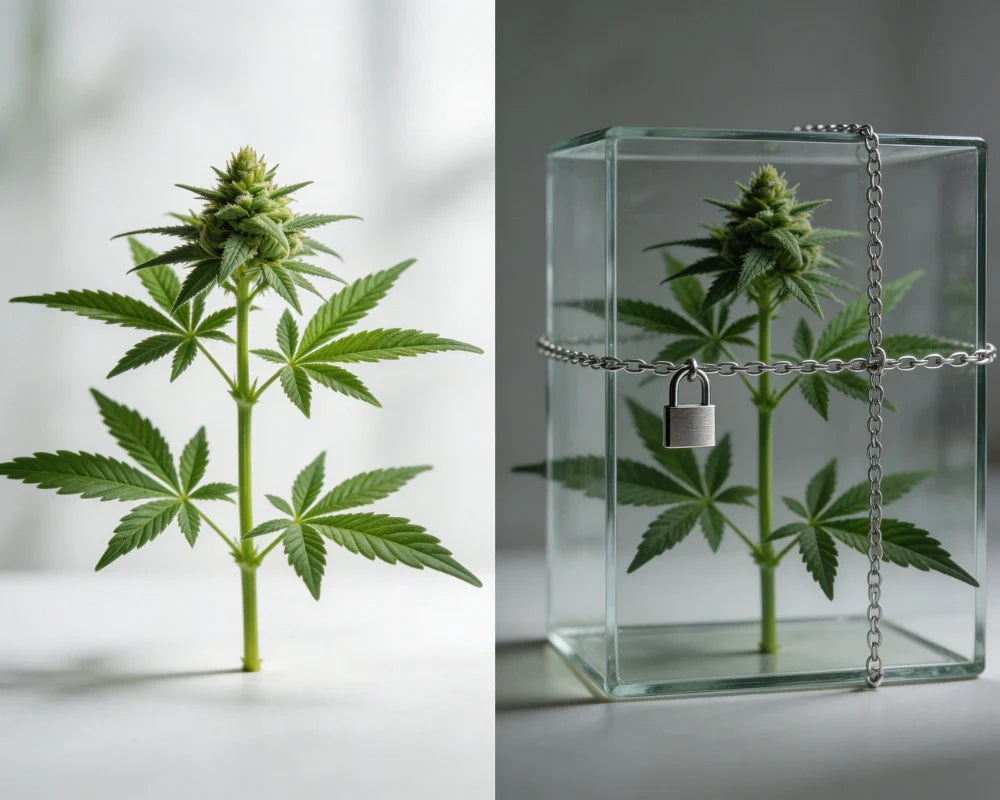
THCa legality in the United States is one of the most asked — and most actively changing — questions in the hemp industry in 2026. The situation has two simultaneous truths: THCa hemp flower is federally legal right now under the standard that has been in place since 2018, and that standard is scheduled to change dramatically on November 12, 2026 under a law signed in November 2025. Understanding both realities — what is legal today, and what is changing — is essential for any hemp consumer in 2026.
This article explains the current federal legal status of THCa, the specific legislation that is changing it, the Congressional response currently underway, the state-level picture, and what this means practically for Canapuff customers right now.
Legal disclaimer: This article is for general informational purposes only and does not constitute legal advice. Hemp and cannabis laws change frequently at both federal and state levels. Canapuff is not a law firm and cannot provide legal advice specific to your situation. For questions about your own legal circumstances, consult a licensed attorney. All Canapuff products are sold in compliance with applicable federal law as of the date of purchase.
Right Now (March 2026): THCa Is Federally Legal
As of March 2026, THCa hemp flower, vapes, and gummies remain federally legal in the United States under the framework established by the Agriculture Improvement Act of 2018 — the 2018 Farm Bill (P.L. 115-334). That law removed hemp from the federal Controlled Substances Act and defined hemp as Cannabis sativa L. and its derivatives containing no more than 0.3% delta-9 THC by dry weight. Because THCa is chemically distinct from delta-9 THC in its raw form, products with high THCa concentrations but compliant delta-9 THC levels have been legally sold as hemp since 2018.
Canapuff's products are tested and certified under this standard. Every product ships with a COA (Certificate of Analysis) from an independent accredited laboratory confirming delta-9 THC at or below 0.3% by dry weight — the current controlling federal legal threshold.
Current legal status in plain English: Purchasing, possessing, and receiving THCa hemp flower from a compliant vendor like Canapuff is federally legal today — and has been since 2018. You are not violating federal law. The law that changes this has been passed but does not take effect until November 12, 2026.
What Is Changing: P.L. 119-37 and the New Hemp Definition
On November 12, 2025, President Trump signed the Continuing Appropriations, Agriculture, Legislative Branch, Military Construction and Veterans Affairs, and Extensions Act, 2026 (P.L. 119-37). Section 781 of this law makes the most significant change to federal hemp regulation since the 2018 Farm Bill itself, specifically targeting what critics called the "THCA loophole."
The law makes three principal changes to the federal definition of hemp:
Change 1: Total THC standard replaces delta-9-only standard
The new definition changes the 0.3% threshold from delta-9 THC only to total THC, including THCA. Under the formula established in cannabis testing (Total THC = delta-9 THC + 0.877 × THCA), a flower product testing at even 5% THCA would far exceed the 0.3% total THC limit — let alone the 20–30% THCA products currently on the legal hemp market. The Congressional Research Service has confirmed this interpretation in multiple published briefings.
Change 2: Finished product container cap of 0.4 milligrams
Final retail hemp-derived cannabinoid products — the products consumers actually buy — may not contain more than 0.4 milligrams of total THC per container. This threshold is far below even the lowest-dose hemp products currently sold. A single serving in most gummies, vapes, or tinctures exceeds this limit many times over. The U.S. Hemp Roundtable has estimated this provision alone would eliminate approximately 95% of currently sold hemp-derived cannabinoid products.
Change 3: Synthetic cannabinoids excluded
Cannabinoids that are synthesized or manufactured outside the cannabis plant are explicitly excluded from the hemp definition. This language primarily targets delta-8 THC (produced commercially via chemical isomerization of CBD) and similar laboratory-converted cannabinoids, regardless of their delta-9 THC content.
The Timeline: What Happens When
| Date | Event | What it means |
|---|---|---|
| December 20, 2018 | 2018 Farm Bill signed (P.L. 115-334) | Hemp defined as cannabis with ≤0.3% delta-9 THC; THCa products become federally legal |
| November 12, 2025 | P.L. 119-37 signed into law | New total-THC definition passed; one-year transition clock begins; current products remain legal |
| December 18, 2025 | Trump executive order on marijuana rescheduling | DOJ directed to move marijuana to Schedule III; also directs new hemp-derived cannabinoid regulatory framework |
| January 13, 2026 | Hemp Planting Predictability Act introduced (H.R. 7024 / S. 3686) | Bipartisan bill in Congress would push effective date to November 2028; currently in committee |
| February 2026 | 2026 Farm Bill draft filed; CSRA introduced in Senate | Competing legislative proposals seek longer-term regulatory framework for hemp cannabinoids |
| Now (March 2026) | Current status | THCa hemp products remain federally legal; P.L. 119-37 not yet in effect; Congress actively debating |
| November 12, 2026 | P.L. 119-37 currently scheduled to take effect | High-THCa products would fall outside new hemp definition unless Congress acts to delay or revise the law before this date |
The Congressional Response: Bills in Play Right Now
The hemp industry has mobilized significant legislative opposition to the November 2025 law, and as of March 2026 there are multiple active bills before Congress:
Hemp Planting Predictability Act (H.R. 7024 / S. 3686)
Introduced January 13, 2026 by Representative Jim Baird (R-IN) with bipartisan co-sponsors, and a Senate companion led by Senators Klobuchar (D-MN), Paul (R-KY), and Merkley (D-OR). The bill simply replaces "365 days" in Section 781 of P.L. 119-37 with "3 years" — pushing the effective date from November 2026 to November 2028. The bill does not change the substance of the new definition; it buys time for Congress to develop a more comprehensive regulatory framework. As of March 2026, H.R. 7024 has been referred to the House Committee on Agriculture and carries 15+ co-sponsors. It has not passed.
Cannabinoid Safety and Regulation Act (CSRA)
Introduced December 2025 by Senators Wyden and Merkley. Rather than a simple delay, the CSRA would replace Section 781 with a permanent federal regulatory framework establishing THC limits of 5 milligrams per serving and 50 milligrams per container for edibles, a federal minimum purchase age of 21, mandatory third-party testing, standardized labeling, and pesticide/heavy metal restrictions. This bill represents the regulation-rather-than-prohibition approach preferred by much of the hemp industry.
H.R. 6209 (Full Repeal)
A separate House bill would repeal the changes to the hemp definition in P.L. 119-37 entirely, returning to the 2018 Farm Bill delta-9-only standard. Less likely to advance given the bipartisan concern over unregulated intoxicating hemp products that motivated the original law.
Farm Bill Reauthorization (2026)
House Agriculture Committee Chairman Glenn Thompson filed an 802-page draft Farm Bill in February 2026. The draft addresses industrial hemp producers but does not directly address the consumable product ban, with the Chairman taking the position that finished goods regulation falls outside Agriculture Committee jurisdiction. The Farm Bill process could still become a vehicle for hemp provisions through amendment or negotiation.
The bottom line: as of March 2026, no corrective legislation has passed. The November 12, 2026 effective date remains the controlling deadline. Whether Congress acts before then is the central open question for the entire hemp industry.
The Marijuana Rescheduling Development
A significant parallel development: on December 18, 2025, President Trump issued an executive order directing the Department of Justice to take all steps necessary to move marijuana from Schedule I to Schedule III of the Controlled Substances Act. The December 2025 executive order specifically also directs agencies to develop a new regulatory framework for hemp-derived cannabinoid products affected by P.L. 119-37's hemp definition changes.
As of March 2026, the DOJ has not finalized the rescheduling action. The process begun by a May 2024 proposed rulemaking remains ongoing. If marijuana were rescheduled to Schedule III, it would cease to be classified as the most-restricted category of controlled substance and would instead be treated similarly to regulated prescription drugs — potentially opening pathways for cannabis products that currently cannot legally access those markets. How rescheduling would interact with the hemp definition changes in P.L. 119-37 is complex, legally uncertain, and being actively analyzed by the Congressional Research Service and the legal community.
State Laws: The Additional Layer
Federal law establishes the floor — but states have broad authority to restrict hemp products within their borders, and some have gone significantly further than current federal law even before the November 2026 federal deadline:
- Ohio enacted Senate Bill 56 in December 2025, imposing a categorical ban on intoxicating hemp products effective immediately, not waiting for the federal November 2026 date.
- Several other states are actively considering or have begun aligning their hemp laws with the stricter P.L. 119-37 total-THC standard ahead of the federal deadline.
- States that already had restrictions in place before P.L. 119-37 include Hawaii, Idaho, Minnesota, Oregon, Rhode Island, Utah, and Vermont — none of which Canapuff ships to.
Canapuff does not ship to HI, ID, MN, OR, RI, UT, or VT due to state-level restrictions. This list reflects our current assessment of shipping compliance and is reviewed as state laws change. Customers are responsible for knowing and complying with the laws of their own state.
What This Means for Canapuff Customers Right Now
Purchasing from Canapuff today is federally legal. The current law — the 2018 Farm Bill delta-9 THC standard — remains in force until at least November 12, 2026. All Canapuff products are third-party tested for compliance with that standard.
What customers should understand:
- Legal today. Ordering, receiving, and possessing Canapuff THCa products in permitted states is not a violation of current federal law.
- A deadline exists. Unless Congress acts to delay or revise P.L. 119-37 before November 12, 2026, the legal framework for high-THCa hemp products will change significantly at the federal level.
- Congress is actively working on it. Multiple bipartisan bills are in play. Whether any pass before the deadline is uncertain but genuinely possible.
- Drug testing is unaffected by legal status. Regardless of hemp law, activated THCa products produce THC metabolites that will trigger positive results on standard drug screens. Legal status provides no protection from employment or legal drug testing consequences.
- State laws vary and evolve independently. States can and do restrict hemp products regardless of what federal law says. Check the current status in your state before ordering.
Canapuff monitors federal and state regulatory developments closely and will communicate any changes that materially affect our customers and product availability.
Frequently Asked Questions
Is it legal to order THCa flower online right now?
Yes — under current federal law, ordering THCa hemp flower from a compliant vendor is legal for adults in states where hemp-derived intoxicating products are not restricted. The 2018 Farm Bill standard remains in force until November 12, 2026. Canapuff ships with USPS-compliant documentation and COAs confirming delta-9 THC compliance under this standard.
Will my THCa products become illegal in November 2026?
Under P.L. 119-37 as currently written, yes — high-THCa hemp products would no longer meet the federal hemp definition as of November 12, 2026. However, Congress has active bipartisan legislation (particularly H.R. 7024 and S. 3686) that would delay this to November 2028, and other bills that would create a regulatory framework rather than a prohibition. The situation is actively evolving. Canapuff will communicate developments as they occur.
Does legal hemp status protect me from a drug test?
No. Drug tests screen for THC-COOH metabolites produced when any form of THC is processed by the body. Whether the THC came from federally legal hemp flower or from marijuana makes no difference to the test result. If you are subject to drug testing, do not use activated THCa products regardless of their legal status.
What is the difference between the 2018 Farm Bill and P.L. 119-37?
The 2018 Farm Bill set the hemp threshold at 0.3% delta-9 THC only. P.L. 119-37 changes this to 0.3% total THC including THCA — a standard that would make most high-THCa flower products illegal when it takes effect. The new law also adds a 0.4 milligram per container cap on finished hemp products, which is far below any currently sold hemp gummy, vape, or tincture. P.L. 119-37 does not take effect until November 12, 2026, and Congress is actively working on revisions.
Sources & Further Reading
The information in this article draws from the following official government and legal sources. All links go to official US government websites or Wikipedia — no commercial sources.
- Agriculture Improvement Act of 2018 (P.L. 115-334) — The original 2018 Farm Bill establishing the delta-9 THC hemp definition. Congress.gov.
- Continuing Appropriations and Extensions Act, 2026 (P.L. 119-37), Section 781 — The November 12, 2025 law amending the federal hemp definition. Congress.gov.
- CRS Insight IN12620 — "Change to Federal Definition of Hemp and Implications for Federal Enforcement" — Nonpartisan Congressional Research Service analysis of P.L. 119-37's scope and enforcement implications. Congress.gov.
- CRS In Focus IF13136 — "Changes to the Statutory Definition of Hemp and Issues for Congress" — Agricultural policy analysis of the definitional changes and legislative considerations. Congress.gov.
- CRS Legal Sidebar LSB11381 — "Changes to the Federal Definition of Hemp: Legal Considerations Under the Controlled Substances Act" — CSA and controlled substances implications of the new hemp definition. Congress.gov.
- H.R. 7024 — Hemp Planting Predictability Act (119th Congress) — House bill to extend the P.L. 119-37 effective date from November 2026 to November 2028. Congress.gov.
- S. 3686 — Hemp Planting Predictability Act, Senate companion (119th Congress) — Senate version of the delay bill led by Senators Klobuchar, Paul, and Merkley. Congress.gov.
- Executive Order — "Increasing Medical Marijuana and Cannabidiol Research," December 18, 2025 — Presidential directive to the DOJ to move marijuana to Schedule III and develop a new hemp cannabinoid regulatory framework. WhiteHouse.gov.
- CRS Legal Sidebar LSB11105 — "Legal Consequences of Rescheduling Marijuana" — Analysis of the rescheduling process and its interaction with existing hemp law. Congress.gov.
- USDA Agricultural Marketing Service — Hemp Program — Federal agency responsible for hemp production oversight and regulatory guidance under the Farm Bill framework. AMS.USDA.gov.
- FDA — Regulation of Cannabis and Cannabis-Derived Products — FDA's official guidance page on cannabis, CBD, hemp, and regulatory status of derived compounds. FDA.gov.
- Wikipedia — "Hemp" — General reference overview of hemp history, botany, and legal classification under US law.
This article is for general informational purposes only and does not constitute legal advice. Laws regarding hemp and THCa are subject to rapid change at both federal and state levels. All Canapuff products comply with applicable federal law as of the date of sale, containing less than 0.3% delta-9 THC on a dry weight basis per the current 2018 Farm Bill standard. Canapuff is not responsible for changes in law after the date of purchase. Customers are responsible for compliance with the laws of their own state. Must be 21 or older. Not available in HI, ID, MN, OR, RI, UT, or VT.
Leave a comment
This site is protected by hCaptcha and the hCaptcha Privacy Policy and Terms of Service apply.