
Table of contents
The same strain of THCa flower can produce very different experiences depending on how you consume it. Smoked, vaped, or eaten as a gummy — the THCa enters your body through different pathways, is processed by different organ systems, and arrives at the brain in different chemical forms on very different timelines. Understanding these differences isn't just useful trivia. It's the single most practical piece of knowledge for anyone who wants to reliably get the experience they're looking for — and avoid the ones they're not.
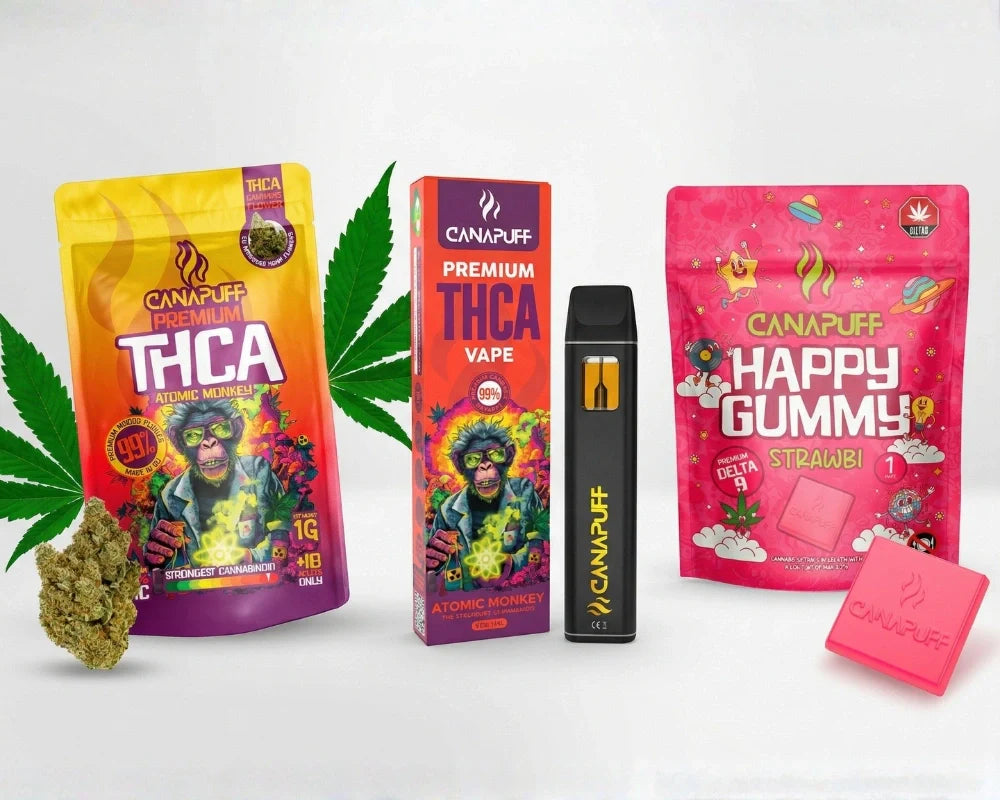
This article covers the pharmacology, practical differences, and decision framework for every consumption method available through Canapuff's product lineup: smoking flower, vaping THCa disposables, and THC gummies.
The Fundamental Variable: How THC Gets Into Your Bloodstream
Every consumption method ultimately delivers activated THC to your brain's CB1 receptors. The differences — in onset time, effect intensity, duration, and character — come down to which pathway the cannabinoids travel to get there, and what happens to them along the way.
There are two primary routes relevant to Canapuff's products:
- Inhalation (smoked flower and vaped THCa) — Cannabinoids enter the lungs, where they cross the alveolar membrane directly into the bloodstream. They reach the brain within minutes. The liver does not process them first.
- Oral ingestion (gummies) — THC is absorbed through the digestive tract, processed through first-pass metabolism in the liver, and converted into a different, more potent compound before reaching the brain. This takes significantly longer but lasts much longer and feels qualitatively different.
That liver processing step — called first-pass metabolism — is the single biggest reason edibles feel different from inhaled cannabis, and it's worth understanding in some detail.
Method 1: Smoking THCa Flower
What happens physiologically
When you light and inhale THCa flower, heat converts THCa to active THC through decarboxylation. The smoke carries activated THC, terpenes, and other cannabinoids through the airways and into the alveoli of the lungs — tiny air sacs with an enormous surface area designed for rapid gas exchange. Cannabinoids cross this thin membrane directly into the capillaries, entering systemic circulation and reaching the brain within approximately 5–15 minutes.
Bioavailability from smoking averages around 25–31%, though this varies considerably based on inhalation technique — depth of breath, duration of hold, and spacing between draws all affect how much THC is actually absorbed. Some THC is also lost to sidestream smoke and pyrolysis (burned off before inhalation).
Onset, peak, and duration
- Onset: 5–15 minutes
- Peak: 20–40 minutes
- Duration: 1.5–3 hours, with gradual tapering
Character of the experience
Smoked flower delivers the complete sensory and flavor profile of the strain — the aroma, the terpenes, the texture of the smoke. Many experienced cannabis users prefer flower specifically for this holistic, ritualistic, and full-spectrum experience. The rapid onset makes dose control relatively manageable: one draw, wait 15 minutes, assess.
The honest health consideration
Combustion produces tar, carbon monoxide, and particulates — the same compounds responsible for respiratory harm in tobacco smokers. Research consistently links regular cannabis smoking with chronic bronchitis, increased respiratory infections, and lung irritation. A March 2026 peer-reviewed review in Current Opinion in Pulmonary Medicine confirmed that while vaping reduces combustion-related toxicant exposure, both smoking and vaping produce comparable acute cardiovascular effects. For occasional use, the respiratory risk is modest. For daily or multiple-times-daily smoking, the cumulative lung exposure is a meaningful health consideration.
Best for:
Users who value the full-spectrum sensory experience of flower, prefer the ritual of smoking, want the fastest onset with intuitive dose control, and are consuming occasionally rather than daily. Canapuff's greenhouse, indoor, and exotic flower grades all support this method.
Method 2: Vaping THCa (Disposable Vapes)
What happens physiologically
THCa oil vapes heat the cannabis oil to a temperature that vaporizes cannabinoids and terpenes without combustion. The vapor — not smoke — is inhaled and absorbed through the same alveolar pathway as smoked cannabis, with the same rapid lung-to-bloodstream transit. The critical difference is in the thermal profile: no burning means no tar, no carbon monoxide, and significantly fewer combustion byproducts.
Vaping is slightly more bioavailable than smoking — estimated at 10–35% depending on the device and draw characteristics, compared to 25–31% for smoking. Some research suggests vaping delivers a higher ratio of active THC relative to combustion byproducts per inhaled volume, which can mean vapes feel more potent per draw than equivalent flower.
Onset, peak, and duration
- Onset: 5–10 minutes (slightly faster than smoking for some users due to higher bioavailability and more consistent draw)
- Peak: 20–40 minutes
- Duration: 1.5–3 hours
Character of the experience
Vaping produces a cleaner, often lighter-tasting experience than smoking. The absence of combustion smoke means the terpene profile of the oil comes through more clearly — a limonene-forward vape like Green Crack tastes noticeably citrusy; a caryophyllene-heavy Runtz vape has a spicy-sweet note. Vapor dissipates faster and with less odor than smoke. A disposable vape like Canapuff's is extremely convenient — no grinding, no packing, no lighter. Draw and done.
One consideration specific to oil vapes: the terpene profile of the oil, and whether it was preserved through live resin extraction or added back artificially after distillation, affects the character of the experience (see entourage effect post for details). Canapuff's THCp vapes use distinct cannabinoid profiles — THCp is significantly more potent than THC at CB1 receptors and produces a more intense, longer-lasting effect from the same volume of oil.
The honest health consideration
Vaping is meaningfully better than smoking for respiratory health — no tar, no combustion products, lower lung irritant exposure. It is not risk-free. Low-quality vape hardware or oils with contaminants (particularly vitamin E acetate, found in illicit and some poorly manufactured products) have been associated with EVALI — e-cigarette or vaping-associated lung injury. Purchasing from reputable, COA-verified sources — where you can verify the oil was tested for residual solvents, heavy metals, and adulterants — is the single most important risk mitigation for vaping. Both acute cardiovascular effects (increased heart rate and blood pressure) occur with vaping as they do with smoking.
Best for:
Users who prioritize convenience and discretion, want the fast onset of inhalation without the respiratory downsides of combustion, are health-conscious about lungs, need portability, or are consuming more regularly and want a lower-irritation option than flower. Canapuff's THCa vapes (Green Crack, Purple Runtz, Northern Lights) and THCp vapes (Blue Slurpicana, Berry ZKZ Belts, Lemon Kushlato) support this method.
Method 3: THC Gummies (Oral Edibles)
What happens physiologically — and why it's different
When you eat a THC gummy, the journey is entirely different. The gummy is digested in the stomach and small intestine, where cannabinoids are gradually absorbed into the portal circulation and transported to the liver. Here — in the first-pass metabolism process — delta-9 THC is metabolized by liver enzymes into 11-hydroxy-THC (11-OH-THC).
11-hydroxy-THC is not the same compound as delta-9 THC. It is more polar, which means it crosses the blood-brain barrier more efficiently. It is more potent — estimated to be up to four times as psychoactively active as delta-9 THC at the receptor level. And it has a longer elimination half-life, meaning it stays active in the brain and body for considerably longer than inhaled THC.
This chemical transformation is the reason edibles feel categorically different from smoked or vaped cannabis — not just "the same but longer." They are genuinely a different pharmacological experience, driven by a different active compound.
Onset, peak, and duration
- Onset: 45 minutes to 2 hours (variable based on stomach contents, individual metabolism, fat content of the gummy)
- Peak: 2–3 hours after consumption
- Duration: 4–8 hours, with a longer and more gradual taper than inhalation
The most important edible rule: Eat a gummy and wait 2 hours before assessing the effect and considering any additional dose. The single most common negative cannabis experience — taking too much — comes from consuming edibles, not feeling anything after 60 minutes, and consuming more. Both doses then peak together. The slow, variable onset of edibles makes real-time titration impossible. Decide your dose before you take it, then commit and wait.
Bioavailability paradox
Edibles have lower raw bioavailability than inhalation — only 4–12% of oral THC reaches the bloodstream, compared to 25–35% for inhalation. But the 11-hydroxy-THC produced by first-pass metabolism is significantly more potent than the delta-9 THC that arrives in the brain via inhalation. The lower bioavailability and higher potency of the active metabolite roughly offset, but the quality and duration of the experience differs substantially.
Character of the experience
Edibles typically produce a more body-centered, sustained, and deeply relaxing experience than inhalation — particularly with indica-dominant formulations. The longer duration makes them well-suited for sleep support (a Berry Kush NR gummy 2–3 hours before bed), extended relaxation periods, and situations where you don't want the experience to conclude quickly. The cerebral component may feel heavier and longer-lasting than with inhalation at equivalent subjective intensity.
The honest health consideration
Gummies are the respiratory-healthiest consumption method — no inhalation at all. The primary risk is overconsumption due to slow, variable onset. Edibles are also where the highest-potency exposures occur, since the 11-OH-THC conversion can make effects significantly more intense than users anticipate from the labeled dose. Start with half a standard serving and wait two full hours.
Best for:
Sleep support, sustained full-body relaxation, situations where smoking or vaping is impractical (travel, indoor spaces), users who prefer not to inhale anything, and those who specifically enjoy the longer, more body-heavy character of oral cannabis. Canapuff's gummy lineup — Berry Kush NR Indica, Raspberry Belts LR Indica, Cherry Slushie LR Hybrid, Peach Mimosa NR Hybrid, Lemon Wreck LR Sativa — covers the full indica-to-sativa spectrum.
Side-by-Side Comparison
| Smoking Flower | Vaping | Gummies | |
|---|---|---|---|
| Onset | 5–15 min | 5–10 min | 45 min–2 hours |
| Duration | 1.5–3 hours | 1.5–3 hours | 4–8 hours |
| Active compound in brain | Delta-9 THC | Delta-9 THC | 11-hydroxy-THC (more potent) |
| Bioavailability | ~25–31% | ~10–35% | ~4–12% (but 11-OH-THC is more potent) |
| Dose control | Good — titrate draw by draw | Good — consistent draw size | Precise label dose, but no real-time adjustment |
| Respiratory health | Lowest — combustion byproducts | Better — no combustion | Best — no inhalation at all |
| Discretion | Low — visible smoke, strong odor | High — minimal odor, compact | Highest — indistinguishable from food |
| Entourage profile | Full — flower preserves complete terpene panel | Good — varies by extraction (live resin > distillate) | Good — NR (natural resin) gummies retain more terpenes than distillate |
| Best use case | Full-spectrum experience, evenings, rituals | Convenience, discretion, daily use, health-conscious inhalation | Sleep support, long relaxation, no-smoke environments |
Mixing Methods: What to Know
Some users combine methods — smoking or vaping flower for an immediate effect, then adding a gummy to extend the duration. This approach requires care: the gummy's peak will arrive 2–3 hours after consumption, potentially overlapping with the tail end of the inhalation effect. The combined peak can be significantly more intense than either method alone. Anyone combining methods should use considerably smaller amounts of each than they would use independently.
Which Method Is Right for You?
Choose smoking flower if: You value the full sensory and terpene experience, enjoy the ritual, are an occasional user, and don't have respiratory sensitivity.
Choose vaping if: You want fast onset with less respiratory impact, need portability and discretion, use more regularly, or want a cleaner flavor from the terpene oil profile.
Choose gummies if: You need long-duration effects (sleep, extended relaxation), prefer not to inhale anything, want the most precise labeled dose, or are in a setting where smoking or vaping isn't practical.
Frequently Asked Questions
Why did the gummy not feel like anything for 90 minutes and then hit much harder than expected?
This is the most common edible experience described by first-time or infrequent gummy users. The variable onset (45 min to 2 hours depending on stomach contents and metabolism), combined with the 11-hydroxy-THC metabolite that is more potent than inhaled delta-9 THC, makes gummies genuinely unpredictable until you've established your personal dose-response pattern. The fix is always the same: start with half a standard serving, wait a full two hours, and resist the urge to re-dose before that window closes.
Do THCp vapes work the same way as THCa vapes?
The delivery mechanism is identical — both are oil vapes with the same onset and duration profile. The difference is in the cannabinoid itself. THCp binds to CB1 receptors with approximately 33 times the affinity of delta-9 THC. Canapuff's Blue Slurpicana, Berry ZKZ Belts, and Lemon Kushlato THCp vapes are therefore significantly more potent per draw than standard THCa vapes. The same start-low principle applies — with THCp products, one short draw is sufficient to start.
Does vaping flower produce a different experience than vaping oil?
Yes. Dry herb vaporizers that heat actual flower produce a more complete entourage profile because the full terpene and minor cannabinoid panel of the flower is present. Oil vape pens deliver a concentrated oil that has been extracted and processed, with terpenes that may have been added back in after extraction. The active cannabinoid dose per draw may be more concentrated in oil vapes, but the full-spectrum character of the experience is richer with whole-flower vaporization.
This article is for general educational and informational purposes only and does not constitute medical advice. All Canapuff hemp products contain less than 0.3% delta-9 THC. These statements have not been evaluated by the Food and Drug Administration. This product is not intended to diagnose, treat, cure, or prevent any disease or condition. Must be 21+ to purchase. Not available in HI, ID, MN, OR, RI, UT, or VT.

Leave a comment
This site is protected by hCaptcha and the hCaptcha Privacy Policy and Terms of Service apply.